
 Login
Login
How Little Wandle Code supports students with SEND and EAL
Research tells us that around one in four Year 7 students do not have the reading skills to access the secondary school curriculum. This can be due to a range of reasons, including missed schooling and students receiving poor phonics instruction in primary school.
Some students may be learning English as an Additional Language (EAL), while others have additional needs such as autism or Social, Emotional and Mental Health (SEMH) needs that have made learning to read more of a challenge.
During our three-year pilot with 60+ mainstream and special secondary schools, staff found that Little Wandle Code was particularly effective for students with SEND or EAL.
Developed specifically for struggling older readers, Little Wandle Code combines direct teaching, consistent routines and age-appropriate resources and delivery.
Read about three of our pilot schools who found Little Wandle Code’s inclusive and flexible design helped them to support students with a range of needs.
Empowering autistic learners through predictability and routine
For one Year 12 student with autism, previous experiences of phonics had left him feeling that reading interventions were repetitive and no longer appropriate for his age.
Alongside this, he experienced a range of barriers, including:
- executive functioning difficulties, making it difficult to manage several steps within a task
- reduced working memory, affecting retention of new learning
- anxiety around unfamiliar technical vocabulary
- rigid thinking, particularly when encountering alternative pronunciations or making mistakes
- social communication challenges during collaborative activities
- difficulty coping with changes to routine, staff or learning environments.
Staff responded by adapting the way Little Wandle Code was delivered; providing more of what the student responded well to in the programme. Namely, consistent routines, repeated use of key terminology and sessions taking place at the same time each day to reduce anxiety and increase familiarity.
To further support his learning, staff:
- slowed the pace of teaching
- completed worked examples together
- removed unnecessary pressure to meet fixed weekly milestones
- used Makaton signs and symbols to reinforce language
- addressed misconceptions immediately before they became embedded.
By making small adaptations, staff ensured the Code sessions were a positive and supportive experience and that the student felt comfortable and ready to learn.
Supporting multilingual learners through language-rich teaching
For many students with EAL, decoding is not the greatest challenge.
As Sarah Paxton, Little Wandle Code Programme Developer, explains:
‘The main barrier for EAL learners is often language comprehension rather than word decoding. EAL students frequently perform well in the Phonics Screening Check, which is why we designed Little Wandle Code, so staff could spend more time developing understanding through discussion and comprehension alongside decoding, if necessary.’
One pilot school identified several barriers affecting an EAL learner, including:
- limited vocabulary
- difficulties retaining new language
- uncertainty around English pronunciation
- not yet being fully literate in their first language.
Staff adapted the delivery of Little Wandle Code by:
- reducing the amount of new learning introduced in each session
- revisiting previous learning more frequently
- limiting the number of new curriculum words
- using images to support vocabulary
- revisiting key vocabulary regularly
- rereading core texts several times to build fluency and comprehension.
These minor adaptations enabled the student to develop both language and reading confidence together.
Building confidence for students with SEMH needs
For another pilot school, the greatest challenge was not decoding – it was helping a student believe they could succeed.
The student presented with a range of barriers, including:
- very low confidence as a reader
- significant gaps in learning due to previous absence
- behavioural challenges and ADHD traits affecting concentration
- reduced working memory
- reluctance to engage with age-appropriate reading.
Staff recognised that consistency and relationships were just as important as the teaching itself. They followed guidance in the Code training and ensured sessions took place in a consistent room, following a predictable routine with the same adults delivering the programme.
In addition, they adopted the following adaptations:
- an additional weekly catch-up session when needed
- carefully planned small groups of no more than three students
- close communication with the student’s family
- reward systems to encourage participation
- repetition, visual supports, kinaesthetic activities and processing time.
These small adjustments created a safe, predictable learning environment where the student could build confidence alongside reading skills.
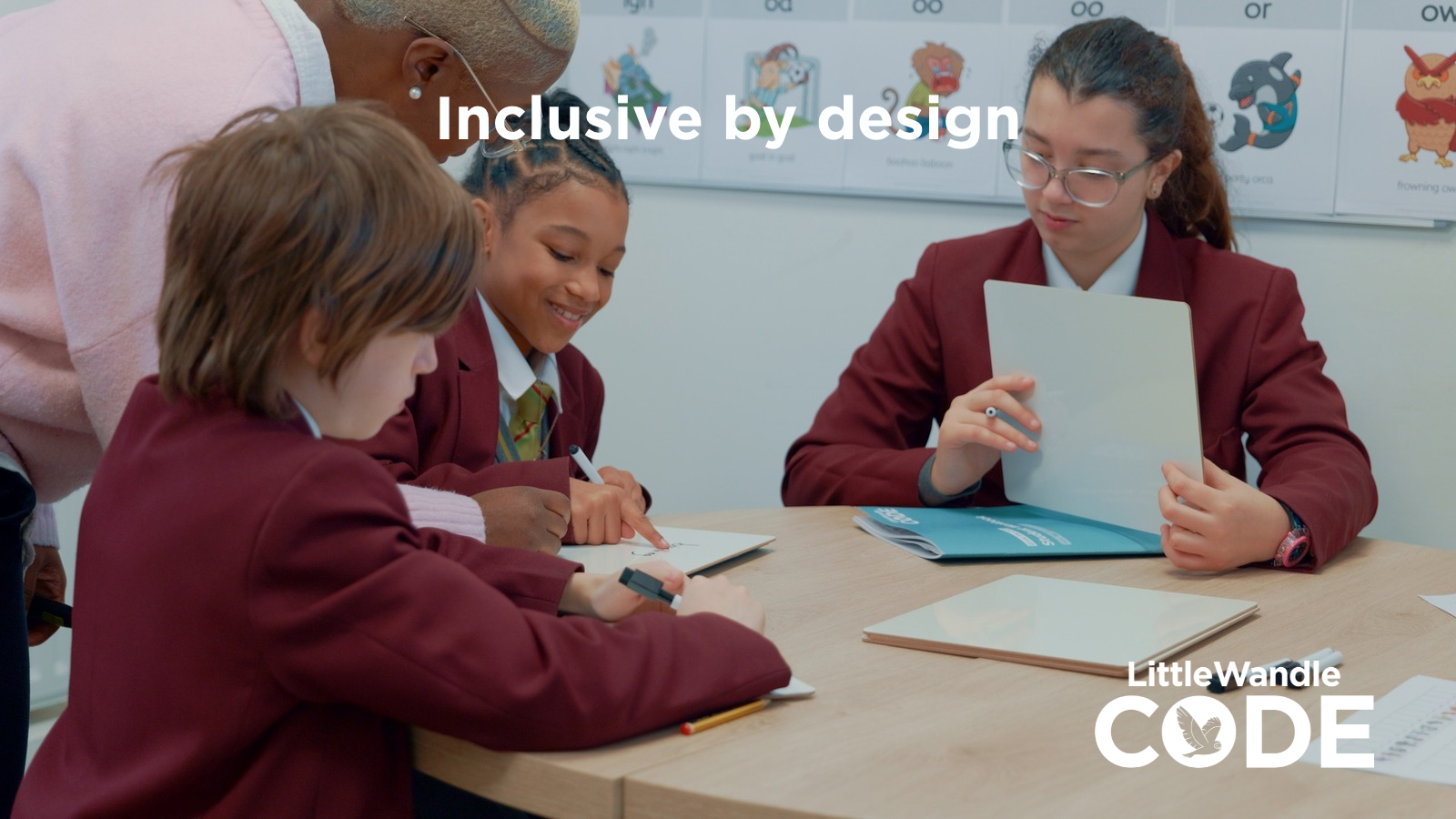
Inclusive by design
Although each student had very different needs linked to EAL or SEND, pilot schools highlighted the following aspects of the Little Wandle Code programme design as being particularly impactful for neurodiverse learners or those with EAL:
- predictable lesson routines
- direct teaching
- the option to slow the pace where needed
- regular review and repetition
- scaffolded language
- images to support vocabulary
- small-group teaching
- immediate feedback.
By making minor adaptations to the programme, outlined in the Code Training Module 7 (Ensuring progress), pilot schools ensured all students could be successful.
Teach reading: change lives
Little Wandle Code Programme Developer, Sarah Paxton, says:
‘The brilliant feedback on individual students from our pilot schools suggests that Little Wandle Code is effectively supporting them to reach every child – which is exactly what the programme is intended to do.
‘Whether working with autistic students, multilingual learners or students with SEMH needs, schools find that Little Wandle Code’s inclusive design is giving them the tools to make a life-changing difference to struggling readers.’