
 Login
Login
Motivating struggling KS3 readers with stories they want to read
As an author of educational books that are used in schools, and as a teacher myself, I’m aware that young readers in classrooms do not get complete agency in their book choices, like they would if they were just wandering into a bookshop or library.
Educational authoring is a privilege. We write things that are going to be read by thousands of children in thousands of schools, as part of their finite and invaluable learning time. And so that privilege carries responsibility: it is up to me, and to fellow authors and illustrators, to create things that engage, elucidate and entertain.
Motivation matters, enormously
Writing for Little Wandle Code is a particular privilege. Having written lots of books in the Little Wandle primary programmes already, I’m used to having to consider the emotional and personal contexts of my likely readers, alongside their reading proficiency.
Motivation matters, enormously. Writing for a Key Stage 3 audience means creating texts that will hold the interest of 11 to 14-year-olds, and especially those who may have had a bruising and frustrating reading life throughout primary school.
I split my time between being an author, a poet-in-residence and a mythologist – strange CV, I know. During lockdown, I began teaching online, and I taught over a thousand children from all over the world. I taught folklore and mythology, leaning on my own love of the topics.
Whilst I am trained as a primary teacher, and work mostly in primary schools teaching mythology and poetry, I have begun teaching many 11 to 14-year-olds too.
Appealing to the age group
My work on Little Wandle Code has been a natural progression from my work directly with young people this age. I had the chance to write six different texts.
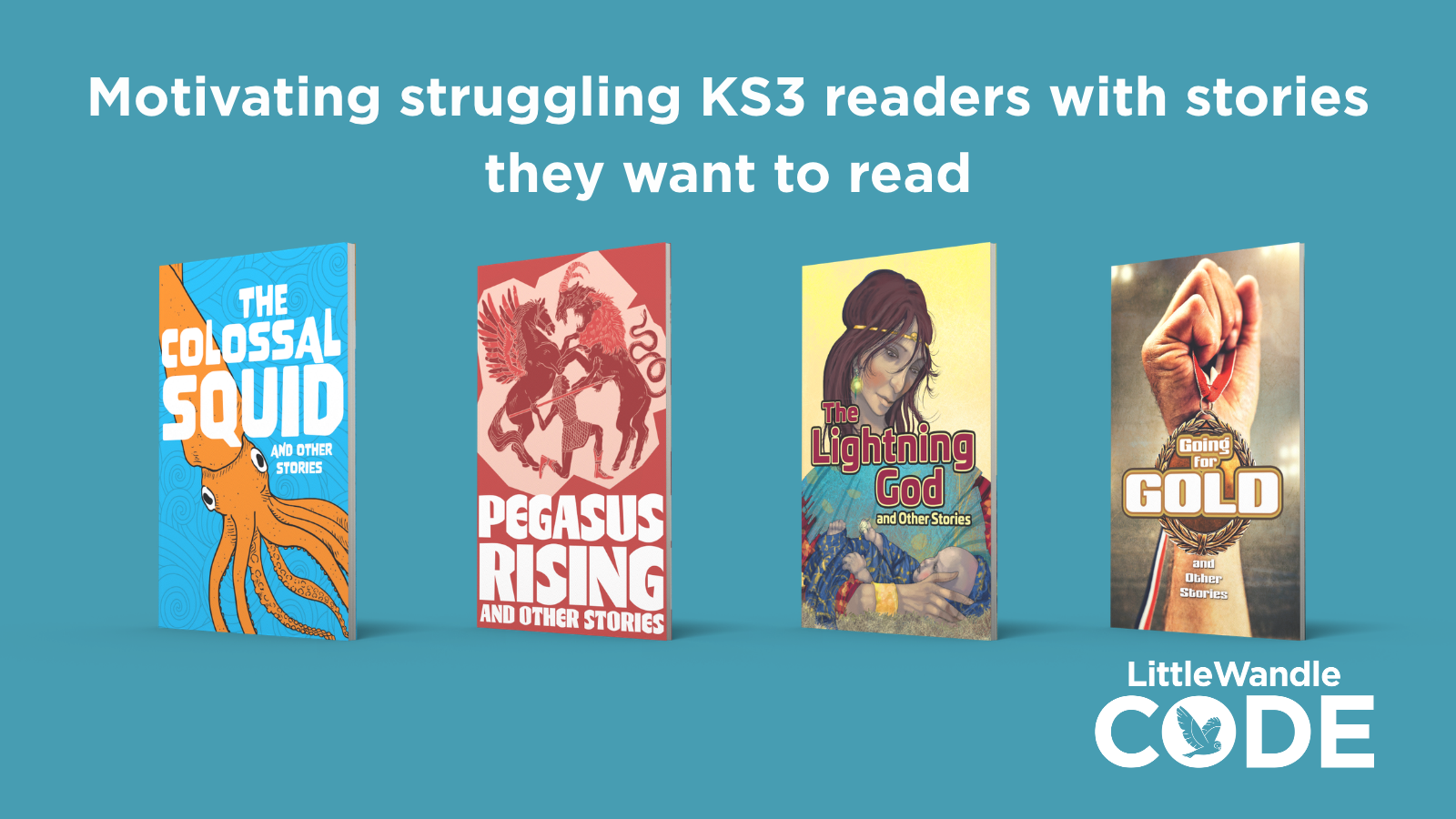
Mythology plays a big part in my collection – I wrote The Goddess of Discord, a long rhyming poem about Eris, whose actions led to the Trojan War, and The Lightning God, about the birth of Zeus. Both of these are stories I know appeal to the age group, but both offered real challenges as an author.
Creating books that are fully phonically decodable turns an author’s life into something like Wordle meets Sudoku meets Only Connect, and this is particularly true when trying to write complex but decodable stories for older readers.
Decodable texts for older readers
The Lightning God, for example, tells the entire story of Zeus without mentioning the word Zeus.
The Goddess of Discord had perhaps the most parameters I have placed on a text in my writing career. It needed to be fully phonically decodable for its level, faithful to the classical myth sources, written in consistent rhyming verse, humorous and informal in its tone, and I also wanted it to contextualise the definitions of new vocabulary within the poem itself.
Creating such things is fun, for those of us – writers and teachers alike – who are obsessed with language nerdery.
Across my six texts then, I wrote a poetry collection about migrating animals, a social history of basketball, two mythological retellings, a funny rhyming tale about a lab explosion, and a horror story I’ve invented about a haunting in Tesco which I have traumatised students with on many a school trip. That is how I Am Gus came about …
Stories with impact
I have worked with so many children in primary and secondary schools whose struggles with reading become destructive to their sense of self, and their confidence in themselves as learners. Likewise, I’ve seen so many children whose abundant knowledge and interest in something – mythology, trains, survivalism, space – can motivate them to persist even when things get tricky in their reading.
I love hearing how the Little Wandle Code anthologies are making an impact in schools across the country, and how the strange and wonderful collections of texts are finding new readers. All children have an entitlement to stories that represent their realities, respect their intelligence, lift their spirit and invite them to remain curious.
Creating these texts is a privilege.
By Jonny Walker, Little Wandle Code author.