
 Login
Login
Pilot schools describe the impact of Little Wandle Code
When students arrive at secondary school unable to read confidently, the impact reaches far beyond English lessons. It affects them in every subject, their confidence in the classroom and, often, how they see themselves as learners.
That’s why we developed Little Wandle Code—an evidence-informed phonics intervention and assessment programme designed specifically for struggling readers in Key Stage 3.
Following our three-year Little Wandle Code pilot involving over 60 mainstream and special secondary schools across the country, we asked staff and students to share their experiences.
Their feedback reveals that the impact of Little Wandle Code goes way beyond improvements in reading scores: it showed young people beginning to see themselves as readers for the first time.
Growing confidence
Across almost every pilot school, one benefit appeared again and again in the feedback: increased confidence.
Staff described watching hesitant readers become willing participants, volunteering to read aloud and tackling unfamiliar words independently.
Sam Walker, Teacher at Hall Cross Academy, Doncaster said:
‘They have become far more confident, fluent readers. They love the assessments and take pride in scoring 100%. They volunteer to read aloud at every opportunity.’
Julia Dele-Fane, Librarian at Sir Thomas Boughey Academy, Staffordshire reflected on the pride students developed as they progressed:
‘What stands out the most is how proud they become of their progress – even the ones who are still unsure of their abilities are beginning to tackle challenges independently from the guided support they receive.’
For many staff, the most rewarding moments were seeing students realise that reading was becoming easier.
Amanda Halahan, Higher Level Teaching Assistant at Tudor Grange Samworth Academy, Leicester described ‘… seeing the progress and the confidence build within my … group.’
While Julia Dele-Fane summed up those breakthrough moments perfectly:
‘It is amazing to watch the ‘Eureka’ moment.’
Small steps. Big progress
Time and again, staff reported students valuing the repetitive structure of the sessions, which enabled them to focus on the content rather than needing to learn a new activity in each session. This was particularly true for neurodiverse learners who thrived on the routines and familiarity.
For one Year 7 student at Danebury School, Hampshire, initial scepticism soon disappeared.
Learning Support Assistant Karen Sturgess recalled:
‘One child initially felt that the Start the Code programme was too basic for a Year 7 student. However, over time, they recognised that it had significantly improved their ability to read and decode words more easily.’
More generally, students said they enjoyed the short, focused sessions; working alongside peers with similar reading abilities; decoding activities; competitions and the opportunity to experience success every week.
The right texts
Choosing texts for struggling older readers can be a challenge with the need to balance words that they can read with themes and formats that don’t feel childish.
Pilot schools told us that the decodable anthologies created specifically for the Little Wandle Code programme by Collins achieved exactly that.
Staff described them as being:
- ‘really engaging stories’
- ‘more grown up’
- ‘interesting, not ‘babyish’’
- ‘funny’
- ‘relevant and interesting’.
Staff also valued the variety of fiction, non-fiction and poetry, giving students opportunities to experience a wide range of texts while continuing to practise decoding.
Feeling like a reader
The most powerful feedback about the Little Wandle Code decodable anthologies came from the students themselves.
Hareem from Royds Hall in Huddersfield shared:
‘I read faster now and feel more confident reading. I read aloud in my English lessons more now because of Little Wandle Code.’
Bukhari from Tudor Grange Samworth Academy, Leicester explained how the programme had changed the way they approach unfamiliar words:
‘I break down words I don’t know into syllables and code them.’
Rodina from Montpelier High School, Bristol added:
‘If I am stuck on a longer word, I code it out, reread it and the word becomes familiar and it makes more sense.’
Other students simply said:
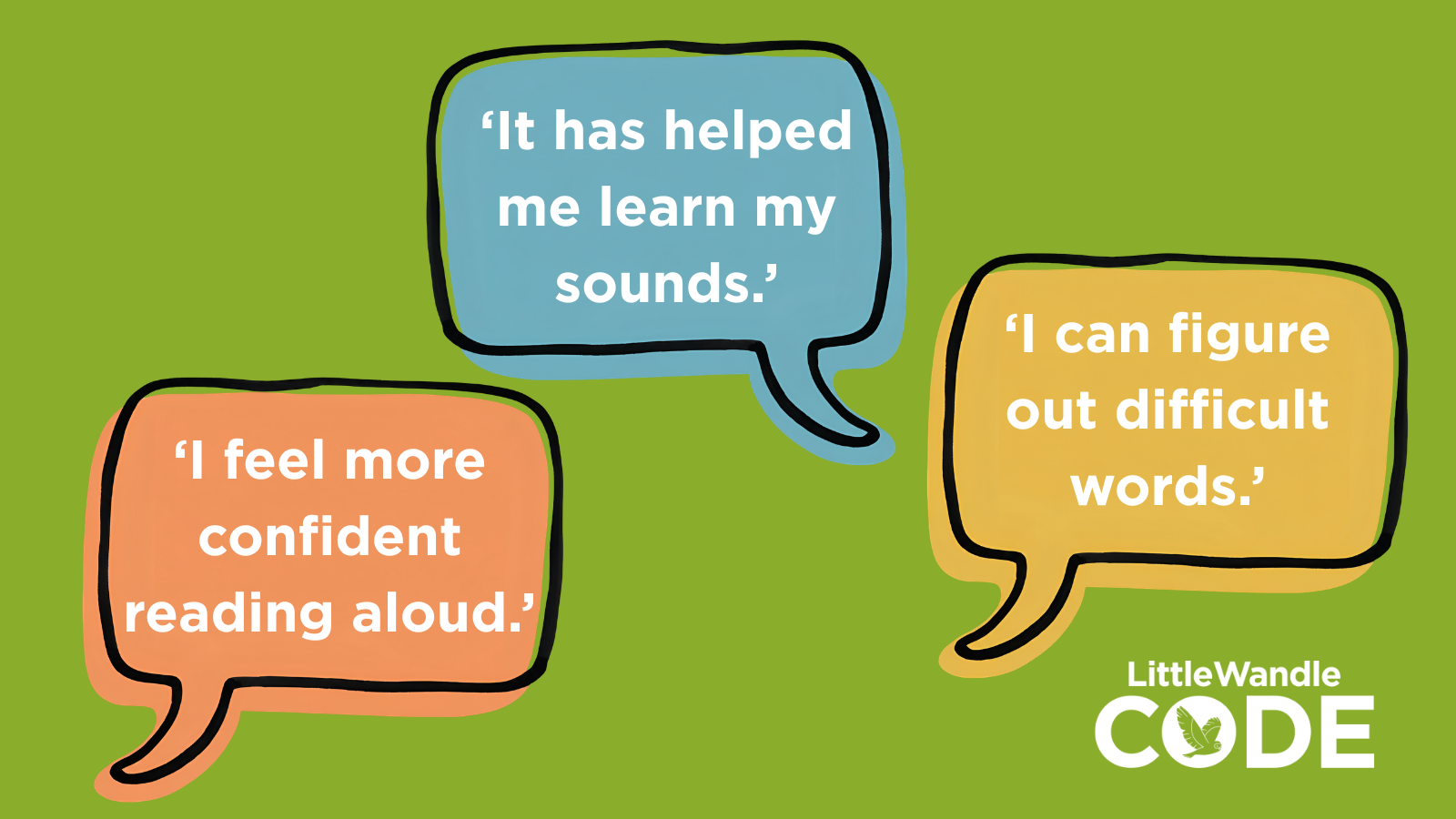
‘I feel more confident reading aloud.’
‘It has helped me learn my sounds.’
‘I can figure out difficult words.’
These comments demonstrate more than improved decoding. They show students developing independent reading strategies they can apply across the curriculum.
Teach reading: change lives
Working with 60+ mainstream and special secondary schools in the development of Little Wandle Code means it’s a phonics solution for Key Stage 3 that has been tailor-made.
Pilot school staff have seen increased confidence, improved fluency, stronger assessment outcomes and students who are increasingly willing to read independently.
Most importantly, students themselves recognise the difference.
As one student put it:
‘Coding my phonics has helped me and I now join in and put my hand up.’
For us, that’s what Little Wandle Code is all about.
Supporting all children to read, read well and experience the joy of reading.
Teach reading: change lives.